
SEABOB Weight: Why a lighter Water Toy makes a real difference
Introduction
When choosing a water toy, performance figures naturally attract attention. Power, thrust, diving depth and operating time are easy specifications to compare. But aboard a yacht, there is another number that can have just as much influence on the everyday experience: SEABOB weight.
A SEABOB is rarely handled only once. It may be taken from storage in the morning, moved across the deck, lowered into the water for a guest, recovered after the session, rinsed, repositioned and stored again before exactly the same process starts with another guest. On an active yacht or during a charter, that can happen repeatedly throughout the day. Suddenly, a difference of several kilograms is no longer just something written on a technical sheet.
This is where the current SEABOB F9 becomes particularly interesting. According to the manufacturer’s technical specifications, the standard F9 weighs approximately 22.9 kg, while the more performance-oriented F9 S weighs approximately 25.9 kg. The F9 can also be configured with Battery Capacity Plus, bringing its weight to approximately 24.8 kg while extending operating time from up to 40 minutes to up to 60 minutes.
Those figures are important because SEABOB has managed to combine a relatively low weight with the characteristics expected from its latest generation. The F9 still delivers 60 TP of thrust performance, a 2.6 kW motor and an electronically configurable diving depth of up to 25 metres. Its construction also incorporates materials including titanium, magnesium and special ceramic coatings, which SEABOB highlights as contributing to durability, performance and manoeuvrability.
For private owners, a lighter machine can simply mean easier ownership. For yacht crew, however, the benefit goes further. SEABOB weight affects every stage between the yacht garage and the water, making it a genuinely practical consideration when deciding which model and how many units should be carried onboard.
Why SEABOB weight matters more on a yacht than you might think
Imagine a yacht carrying four SEABOBs. A guest asks to use them, so the crew needs to prepare the equipment and bring the machines to the appropriate launch area. After the session, every unit has to come back onboard and go through the yacht’s normal post-use routine. The question is no longer simply whether one person can lift a SEABOB. It is how comfortable and practical the equipment remains when it needs to be handled repeatedly.
That is where the 22.9 kg weight of the standard F9 becomes one of its understated advantages. Compared with the F9 S at approximately 25.9 kg, there is a difference of around 3 kg per unit. Across four machines, that represents 12 kg less combined equipment weight being moved during a complete deployment. The comparison is not about suggesting that the F9 S is excessively heavy its additional performance serves a different rider profile but rather showing why the lighter F9 can be particularly attractive when operational simplicity matters.
The benefit becomes even clearer when handling is considered rather than storage weight alone. Moving a compact water toy through a yacht is different from lifting the same weight in a gym. Crew may need to negotiate steps, platforms and restricted spaces while protecting both the equipment and the yacht’s surfaces. A few kilograms removed from something that is regularly lifted and repositioned can therefore make a noticeable practical difference.
Launching and recovery matter too. SEABOB itself offers an inflatable Lifting Dock specifically designed to allow a machine to be lowered into or lifted out of the water using a davit. That accessory alone illustrates how much attention needs to be given to handling a water toy around a yacht rather than considering only its performance once it is in the sea.
For guests, lower SEABOB weight can also make the experience feel more approachable before they even enter the water. Once afloat, buoyancy changes the physical experience considerably, but on deck the machine still has to be positioned and prepared. A more manageable format can be particularly welcome when a SEABOB is being shared between different members of a family or between charter guests with very different levels of physical confidence.
This practical aspect is easy to overlook because SEABOB has traditionally been associated first with performance. Even coverage of earlier generations focused heavily on power: a 2020 article from Le Figaro Nautisme, for example, presented the F5 SR primarily through its performance and its status as a fashionable yacht water toy. With the F9 generation, however, weight deserves to become part of the buying conversation alongside power and autonomy.
The standard F9 is particularly compelling in this respect because choosing the lighter model does not mean reducing the experience to an entry-level product. It retains the F9 generation’s thumb-operated accelerator, Normal and Dive modes, Sport mode and body-weight steering, while delivering 60 TP of thrust performance.
For a yacht carrying several units, that balance can matter more than simply selecting the highest-performance version available. A lighter SEABOB that is easier for crew to deploy, easier to recover and suitable for a broad range of guests may ultimately spend more time in the water and less time in the garage which is arguably one of the most useful measures of any yacht toy.
Discover the SEABOB F9.
Explore the SEABOB F9 S.
Discover the SEABOB SE63 for Automobili Lamborghini.
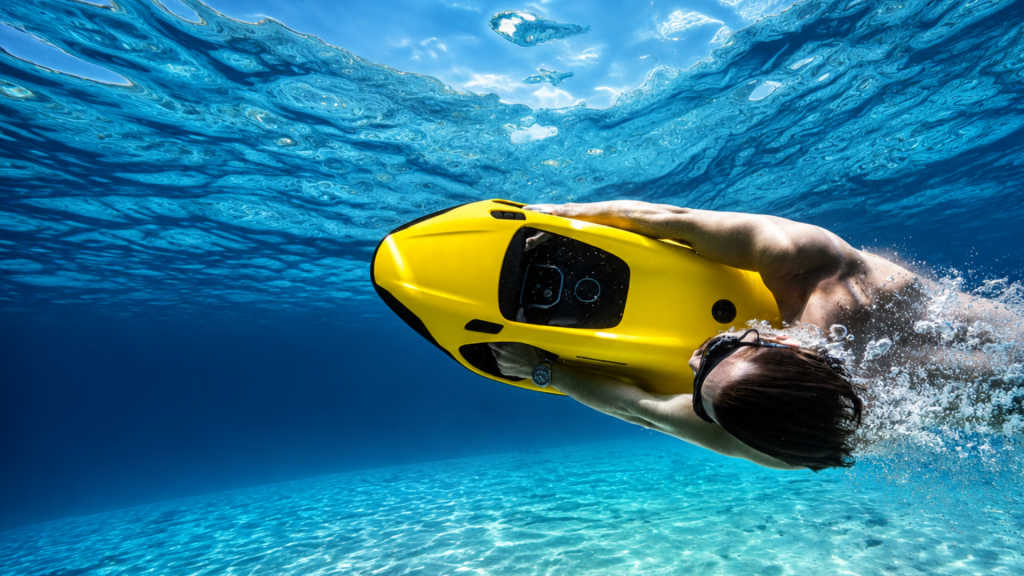
F9 vs F9 S: when does the lighter SEABOB make more sense?
It is tempting to assume that the most powerful SEABOB is automatically the best choice. The F9 S delivers 84 TP compared with 60 TP for the F9, giving experienced riders a more performance-oriented experience. But yacht equipment is not selected purely on maximum performance. When the same machine needs to work for owners, guests and crew, the lighter SEABOB weight of the F9 can become a more meaningful advantage.
The difference starts before anyone enters the water. At approximately 22.9 kg, the standard F9 is around 3 kg lighter than the F9 S at approximately 25.9 kg. That may appear modest on paper, but it represents more than an 11% reduction in weight. When equipment is repeatedly lifted, carried, launched and recovered, reducing the physical load of each individual unit can simplify everyday operations considerably.
For crew, this is particularly relevant on yachts carrying multiple SEABOBs. Four standard F9 units represent approximately 91.6 kg of equipment, compared with around 103.6 kg for four F9 S units. Nobody is moving all four simultaneously, of course, but the comparison illustrates how small differences at product level multiply across an entire yacht-toy inventory. Over a busy charter week, those machines may each be handled dozens of times.
There is another practical advantage: 22.9 kg is easier to manage for a wider range of people. Yacht crews are not identical in height or physical strength, and equipment should ideally remain practical for the team rather than depending on the strongest crew member whenever guests want to use it. Choosing the F9 can therefore contribute to a water-toy setup that is easier to operate consistently.
The same reasoning applies to private clients. A SEABOB may be purchased for a yacht, but it can also travel between the boat, tender, beach, pontoon or waterfront property. If the owner expects to handle the machine personally rather than always relying on crew, SEABOB weight becomes an even more immediate consideration. The lighter F9 can make spontaneous use easier because moving the machine requires less effort before and after every session.
Importantly, choosing the F9 for its lower weight does not mean sacrificing the fundamental SEABOB experience. The current model combines its approximately 22.9 kg standard weight with 60 TP of thrust performance and 2.6 kW of power, while offering Normal, Dive and Sport operating modes. Steering remains controlled through shifts in body weight, maintaining the intuitive riding philosophy of the F9 generation. SEABOB F9 official specifications
Battery choice adds another interesting dimension. The standard F9 offers up to 40 minutes of operating time, while the optional Battery Capacity Plus extends this to up to 60 minutes and increases the machine’s approximate weight to 24.8 kg. That gives buyers a genuine choice: prioritize the lowest possible weight for easier handling, or accept approximately 1.9 kg more for additional operating time. Even with Battery Capacity Plus, the F9 remains slightly lighter than the standard F9 S.
This makes the decision between the two models more nuanced than F9 versus F9 S = less power versus more power. The F9 S makes sense for riders who actively want its additional performance and more dynamic character. The F9 can be the smarter choice when the priorities are versatility, frequent deployment, multiple users and easier handling aboard the yacht.
For charter yachts in particular, that balance can be compelling. The fastest machine is not necessarily the one every guest will choose. A water toy that is accessible to a broader range of riders and less demanding for crew to handle can ultimately provide greater value throughout the season.
This is why SEABOB weight should be considered alongside thrust, battery life and diving capabilities when choosing a model. At Seabob France, clients can compare these practical requirements before deciding whether the lighter F9 or more performance-oriented F9 S better matches their yacht and intended use.
Explore our Delivery & Services.
Contact Seabob France for personalized buying advice.
Follow Water Toys Center on Instagram for SEABOB videos, deliveries and real-world product content.

Why the lighter F9 can make life easier for crew and owners
The value of a lower SEABOB weight becomes most obvious when looking beyond the riding session itself. On a yacht, every water toy creates a small operational cycle: take it from storage, prepare it, move it to the launching area, put it in the water, recover it, rinse it and return it to storage. For a private owner this may happen occasionally. For professional crew during a busy season, it can happen several times in a single day.
At approximately 22.9 kg in its standard configuration, the F9 reduces the effort involved at almost every stage of that cycle. Three kilograms compared with the F9 S may not transform one individual lift, but repeated handling changes the equation. Over days and weeks of operation, lighter equipment can simply be more convenient to work with.
This matters particularly when several SEABOBs are stored onboard. Yacht garages can be tightly organized spaces where equipment has to be moved around other toys, tenders and accessories. The ability to reposition a machine more easily can help during preparation as well as when everything needs to be secured again after use. SEABOB has also reduced the dimensions of the F9 generation compared with its predecessors, describing the new design as significantly more compact while retaining its performance-focused character. Discover the SEABOB F9 design and technology
A lighter machine can also make tender operations more convenient. SEABOBs are not always launched directly from the yacht. They may be transferred into a tender and taken to a beach, bay or different swimming area before being used. Every additional transfer means another moment when weight and dimensions matter. For yachts where water toys regularly move between garage, swim platform and tender, the F9’s more manageable format becomes a practical advantage rather than merely a technical specification.
The benefit extends to clients who do not have permanent crew. A private SEABOB owner may need to move the machine from a car to a pontoon, from storage to the water or between a residence and a boat. In those circumstances, SEABOB weight directly affects how convenient the product feels to own. The easier a water toy is to prepare and move, the easier it becomes to decide to use it spontaneously.
There is also the guest experience to consider. Once the F9 is in the water, its propulsion and buoyancy define the ride, but getting the machine to and from the water remains part of the overall experience. For owners who want a SEABOB that can be shared between family members or different guests, choosing a lighter and more versatile configuration can make sense even when a more powerful version exists.
This does not make the F9 S the wrong choice. Its 84 TP compared with the F9’s 60 TP provides the additional performance that some riders specifically want. The important point is that yacht owners should not automatically treat the higher-performance specification as an upgrade in every situation. For a yacht where SEABOBs are used frequently by many different guests, the standard F9’s balance of performance and lower weight may actually be the more appropriate configuration.
The F9 also illustrates how material engineering can influence usability. SEABOB uses titanium, magnesium and special ceramic coatings within the F9 generation, while the compact design was developed in collaboration with Studio F. A. Porsche. The result is not simply a smaller-looking machine: reducing mass while retaining the performance expected from a modern SEABOB has a direct benefit in real-world ownership.
For clients choosing equipment in France or Monaco, this is exactly the kind of detail that deserves to be considered before purchase. Specifications tell you what a machine can do in the water; they do not always tell you how convenient it will be during the other hours of the day. Through Seabob France, owners and yacht professionals can consider model choice around the way the equipment will actually be stored, handled and used.
Ultimately, the advantage of the F9’s 22.9 kg weight is simple: it removes a little friction from every interaction with the machine. Easier for crew to deploy, easier for owners to move and more practical when several units are carried onboard, the lighter F9 shows why reducing weight can be just as meaningful as increasing performance.
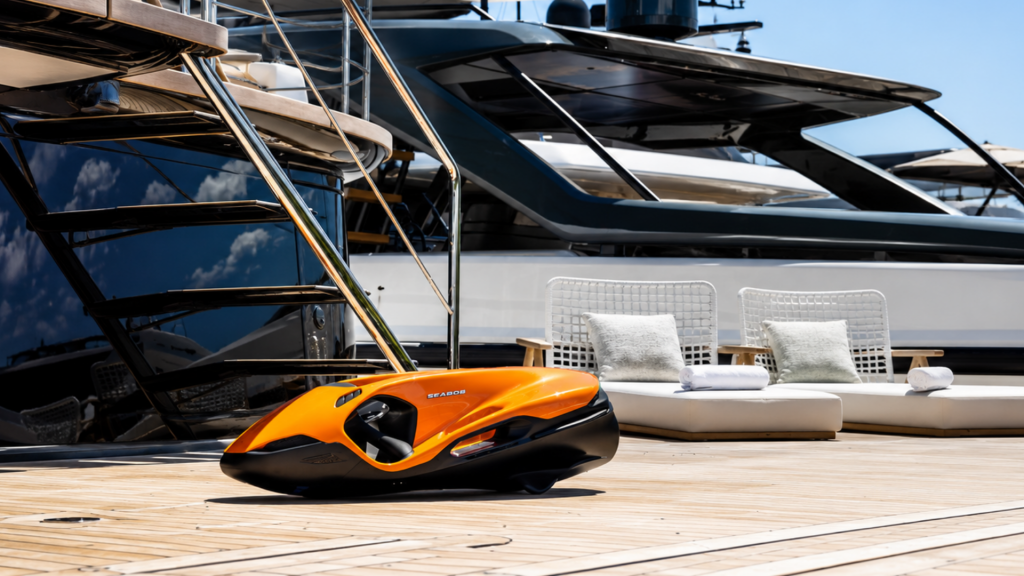
FAQ – SEABOB Weight and the F9
How much does a SEABOB F9 weigh?
The standard SEABOB F9 weight is approximately 22.9 kg. With the optional Battery Capacity Plus, the F9 weighs approximately 24.8 kg. This relatively low weight is one of the F9’s most practical advantages, particularly for yachts where the machine may be moved, launched and recovered several times during the day. Official SEABOB F9 specifications
How much does a SEABOB F9 S weigh?
The SEABOB F9 S weighs approximately 25.9 kg, making it around 3 kg heavier than the standard F9. In exchange, the F9 S delivers higher performance, with 84 TP compared with 60 TP for the F9. The choice therefore depends on whether maximum performance or easier everyday handling is the greater priority.
Is the F9 lighter than the F9 S?
Yes. At approximately 22.9 kg, the standard F9 is around 3 kg lighter than the F9 S, or roughly 11.6% lighter. That difference becomes particularly relevant when several machines are carried onboard or when crew repeatedly deploy and recover them throughout the day.
Why does SEABOB weight matter on a yacht?
A SEABOB needs to be handled before and after every ride. Crew may have to move it through the yacht garage, carry it to the swim platform, transfer it into a tender, launch it, recover it and return it to storage. A lighter machine can make these repeated operations more convenient, especially during busy charter periods.
Is a lighter SEABOB better for yacht crew?
It can be. Lower weight reduces the physical load involved in repeated handling and can make the equipment manageable for a wider range of crew members. For yachts carrying several units, the F9’s combination of 22.9 kg weight and 60 TP performance can therefore provide an attractive balance between operational practicality and the experience offered to guests.
Is the SEABOB F9 still powerful despite being lighter?
Yes. The F9 combines its approximately 22.9 kg standard weight with a 2.6 kW electric motor and 60 TP of thrust performance. It also retains the principal characteristics of the F9 generation, including Normal and Dive modes, Sport mode and intuitive control through body movement. Explore the SEABOB F9
Does the larger F9 battery increase the weight?
Yes. Choosing Battery Capacity Plus increases the F9’s approximate weight from 22.9 kg to 24.8 kg, while extending the stated operating time from up to 40 minutes to up to 60 minutes. This allows buyers to choose between the lightest possible configuration and additional autonomy depending on how the machine will be used.
Should I choose the F9 or F9 S for my yacht?
The F9 can make more sense when lower weight, frequent handling, versatility and use by different guests are priorities. The F9 S is better suited to riders specifically looking for its additional 84 TP performance. For many yachts, choosing the most appropriate SEABOB is therefore about balancing performance with everyday practicality rather than automatically selecting the most powerful model.
Conclusion
When comparing SEABOB models, weight can easily disappear behind more exciting specifications such as thrust, power and diving performance. Yet in everyday yacht operation, SEABOB weight influences something equally important: how easy the machine is to live with before and after every ride.
At approximately 22.9 kg, the standard F9 makes a particularly strong case for itself. Its lower weight can simplify repeated handling for crew, make transfers between yacht, tender and water more manageable and provide private owners with a machine that is easier to move themselves. At the same time, its 60 TP performance means that this practicality does not come at the expense of the core SEABOB experience.
The F9 S remains the logical option for riders who specifically want additional performance. But for owners and captains choosing equipment for multiple guests and frequent use, the lighter F9 demonstrates why the most powerful SEABOB is not automatically the most practical SEABOB. Sometimes, removing a few kilograms can add more value onboard than adding more power.