
SEABOB F5: Should You Upgrade to the F9?
Introduction
Search for a SEABOB F5 today and you will still find one of the models that helped establish SEABOB as a reference in premium underwater water toys. The F5 generation became familiar in yacht garages, beach clubs and Mediterranean anchorages, and many owners discovering the brand for the first time still encounter F5, F5 S and F5 SR machines on the pre-owned market.
But the SEABOB range has moved forward.
For someone considering a SEABOB F5 today, the more useful question is no longer simply “Where can I find one?” It is “Does buying an F5 still make sense when the F9, F9 S and SE63 for Automobili Lamborghini now exist?”
The current F9 generation represents a substantial change in the SEABOB concept. Designed in collaboration with Studio F. A. Porsche, the F9 introduces a new platform with digital thumb-operated acceleration, Normal, Dive and Sport driving modes and a significantly lighter architecture. The standard F9 weighs approximately 22.9 kg, while the more performance-focused F9 S weighs approximately 25.9 kg according to SEABOB’s current technical data.
That reduction in weight is especially relevant aboard yachts. A SEABOB is not only ridden; crew need to remove it from storage, carry it to the swim platform, launch it, recover it, rinse it and return it to the yacht garage. When several machines are being handled repeatedly throughout a charter week, the difference between generations becomes much more noticeable outside the water.
Performance has evolved too. The F9 provides 60 TP of thrust performance from its 2.6 kW motor, while the F9 S increases output to 84 TP with 3.6 kW of electrical power. The F9 can provide up to approximately 40 minutes of sporty operation in its standard configuration or 60 minutes with Battery Capacity Plus, while the F9 S is rated for up to approximately 50 minutes.
And there is now a third proposition that did not exist during the F5 era. The SEABOB SE63 for Automobili Lamborghini takes the concept into another category entirely, combining Lamborghini-specific design, carbon fibre, titanium and magnesium components with 6.3 kW of electrical power and 162 TP of thrust performance.
So if you arrived here specifically looking for a SEABOB F5, that does not necessarily mean the F5 is the machine you should leave with. Understanding what has changed can reveal whether an older-generation SEABOB still fits your needs or whether moving directly to the latest platform makes more sense.
Explore the current SEABOB F9, F9 S and SE63 range at SEABOB France.
From SEABOB F5 to F9: what has actually changed?
Moving from the SEABOB F5 generation to the F9 is not simply a question of replacing an old model name with a new one. The latest generation changes the way the machine is controlled, handled and integrated into everyday yacht use.
One of the clearest differences is the cockpit and throttle system. The F9 introduces a digital thumb-operated accelerator with infinitely variable power adjustment. Riders can switch between Normal and Dive modes, with Dive mode providing more sensitive power delivery underwater, while Sport mode unlocks maximum motor performance for more dynamic surface riding.
The physical design has changed significantly as well. Studio F. A. Porsche developed the F9 around a combination of functional and sportive design, but the benefit is not purely aesthetic. At 1,023 × 526 × 343 mm, both the F9 and F9 S use a compact platform, while the standard F9’s approximately 22.9 kg weight makes handling one of the defining advantages of the newer generation.
For a private owner using one machine occasionally, weight might seem like a secondary specification. For a superyacht carrying several SEABOBs, it can become one of the most important. Every unit may be moved multiple times during a single day, and crew efficiency matters just as much as the experience guests have once the machine reaches the water.
The F9 generation also creates a clearer choice between versatility and outright performance. The F9’s 60 TP configuration provides the latest platform in its lighter form, while the F9 S raises thrust performance to 84 TP and adds the Driving Stability System with extendable stern stabilisers alongside its two underbody foils.
This means someone researching a SEABOB F5 because it is the model they already know should avoid comparing only purchase prices. An older machine may initially appear attractive, particularly on the pre-owned market, but the comparison should also include weight, controls, battery condition, charging setup, accessories, warranty and the type of technical support available for the machine.
For yacht owners, there is another factor: how long the equipment is expected to remain onboard. Buying into the current F9 platform provides access to the present accessory ecosystem, including dedicated Quick Chargers, transport bags, protective covers, storage racks, Pilot Belt System and the Lifting Dock for davit-assisted launch and recovery.
The F5 therefore remains an important part of the SEABOB story, but buyers searching for one today have something previous F5 customers did not have: the option to compare it against an entirely newer generation before making the decision.
For current availability and pricing, browse the SEABOB France shop.
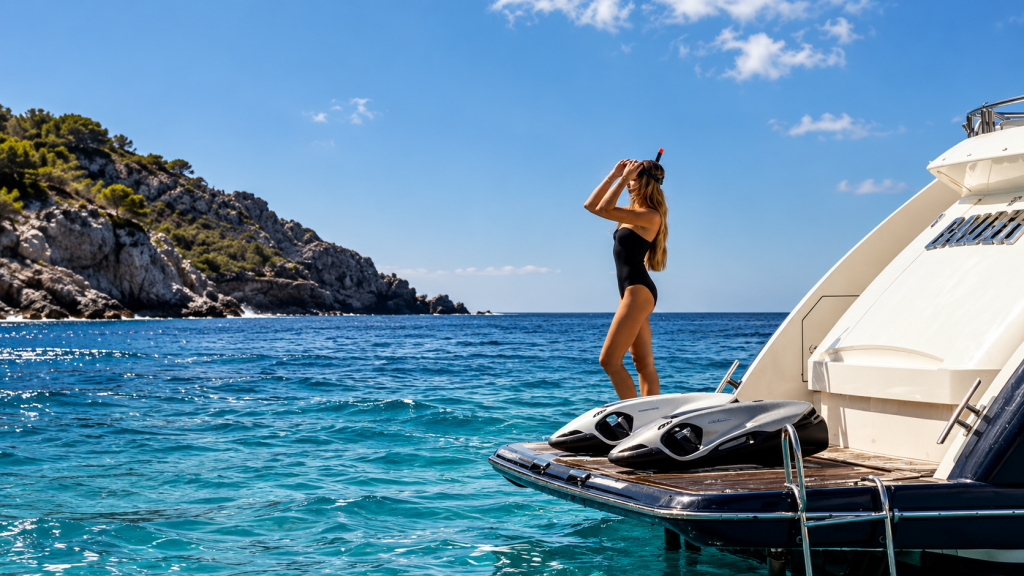
SEABOB F5 vs F9: why weight matters more than you might expect
One of the clearest differences between the SEABOB F5 generation and today’s F9 is visible before either machine even enters the water. An official historical SEABOB price list specified the F5 at approximately 29 kg and the F5 S at approximately 34 kg. By comparison, the current F9 weighs approximately 22.9 kg in standard configuration, while the F9 S weighs approximately 25.9 kg.
That means someone researching an F5 today should not look only at propulsion or purchase price. Moving from approximately 29 kg on the F5 to 22.9 kg on the F9 represents a reduction of around 6 kg per machine. Compared with the old F5 S, the difference to the F9 S is around 8 kg. On a yacht carrying several units, that becomes particularly noticeable for crew.
SEABOB itself now highlights this reduced weight as one of the improvements over previous models, specifically noting that the F9 is easier to handle both in and out of the water and is better suited to boats where space and handling matter.
Think about what happens during a normal charter day. The machines leave their storage racks, are moved to the swim platform, launched for guests, recovered, rinsed and eventually returned to the yacht garage. That process can happen repeatedly. A lighter generation does not simply look better on a technical sheet; it can reduce the effort associated with using the equipment every day.
The F9 also uses the same compact dimensions for both versions 1,023 × 526 × 343 mm allowing an owner to choose between the lighter F9 and more powerful F9 S without moving to a fundamentally larger platform.
This is an important reason why someone arriving at SEABOB France specifically searching for a SEABOB F5 should compare generations before deciding. An F5 may still provide the SEABOB experience, but the newer F9 platform addresses practical considerations that become especially important aboard yachts.
Explore the SEABOB F9 Series at SEABOB France.
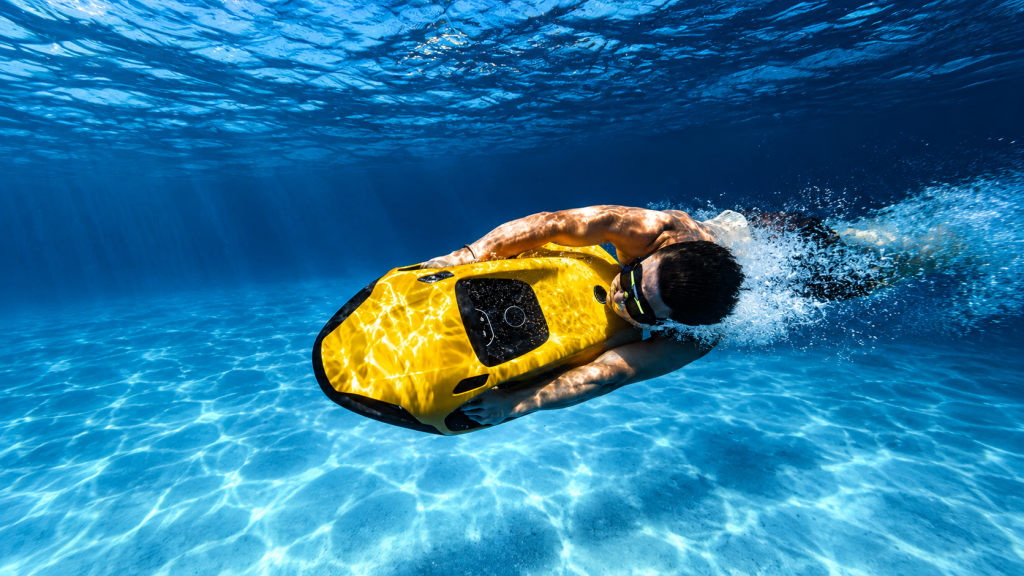
F9 or F9 S: which is the logical upgrade from a SEABOB F5?
Moving away from the SEABOB F5 does not mean automatically choosing the most powerful machine available. The F9 generation now provides two different directions depending on how the SEABOB will actually be used.
The standard F9 is arguably the more significant evolution for owners prioritising everyday usability. Its 60 TP thrust performance, 2.6 kW motor and 22.9 kg standard weight create a combination designed around performance without sacrificing handling. Standard operating time is rated at up to approximately 40 minutes with a sportive riding style, increasing to 60 minutes with Battery Capacity Plus.
The F9 S shifts the balance toward stronger performance. Power rises to 3.6 kW and 84 TP, while the machine incorporates SEABOB’s Driving Stability System with extendable stern stabilisers and two foils on the underbody. Operating time is rated at approximately 50 minutes, and weight increases to around 25.9 kg.
For someone who originally searched for an F5 because they want a straightforward SEABOB for family or yacht-guest use, the F9 may therefore be the more relevant model to investigate first. It brings the latest platform and lower weight without necessarily prioritising maximum output.
Someone who was specifically considering an F5 S or F5 SR for stronger performance has a different reason to look at the F9 S. The current model adds more than additional thrust: the stability system and newer control architecture change how that performance is delivered and managed on the water.
For yacht owners, there is also no requirement to make every unit identical. A collection could prioritise F9 machines for general guest use while including an F9 S for owners or experienced riders wanting the higher-performance configuration. This can be more useful than simply purchasing several examples of whichever model has the highest specifications.
The important point is that a search for SEABOB F5 in 2026 should lead to a comparison, not an automatic purchase of the older generation. The F5 tells you the type of experience you are looking for; the F9 and F9 S show how that experience has since evolved.
Compare the current models on the official SEABOB F9 Series page.
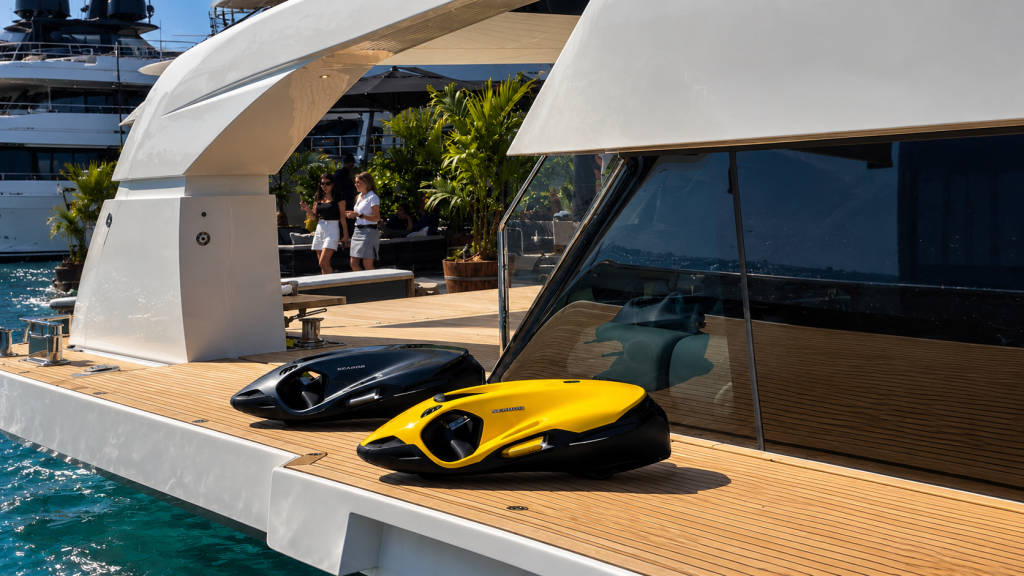
FAQ – SEABOB F5 vs the New F9 Generation
Is the SEABOB F5 still available?
The SEABOB F5 belongs to the previous SEABOB generation and may still be found on the pre-owned market. Buyers considering one today should compare its age, battery condition, charging equipment and service history with the advantages of purchasing a current-generation F9 or F9 S.
What replaced the SEABOB F5?
The current range is centred around the SEABOB F9 and F9 S. Rather than being a simple visual update, the F9 generation introduces a lighter architecture, new digital controls, different riding modes and updated performance characteristics.
What is the weight difference between the SEABOB F5 and F9?
Historical SEABOB documentation listed the F5 at approximately 29 kg, while the current standard F9 weighs approximately 22.9 kg. That reduction of around 6 kg can be particularly valuable for yacht crew repeatedly launching, recovering and storing several machines.
Should I buy a SEABOB F5 or F9?
It depends on budget and intended use. A used F5 may remain attractive to someone specifically looking for an older-generation machine, but the F9 provides the latest SEABOB platform, lower weight and current accessories. Buyers should therefore compare the total ownership proposition rather than looking only at the purchase price.
What is the difference between the F9 and F9 S?
The standard F9 delivers 60 TP of thrust performance and weighs approximately 22.9 kg, while the F9 S increases output to 84 TP and weighs approximately 25.9 kg. The F9 S also incorporates the Driving Stability System with extendable stern stabilisers and underbody foils.
What if I was looking for a SEABOB F5 S or F5 SR?
If stronger performance was the reason for considering an F5 S or F5 SR, the current F9 S is particularly relevant to compare. It combines the latest-generation platform with higher thrust performance and SEABOB’s newer stability technology.
What about the Lamborghini SEABOB?
The SE63 for Automobili Lamborghini sits in a different category from both the old F5 generation and the F9 range. Developed through the SEABOB and Lamborghini collaboration, it uses carbon fibre, titanium and magnesium components and delivers 6.3 kW of electrical power with 162 TP of thrust performance. It is aimed at buyers looking for considerably greater performance and exclusivity rather than simply an F5 replacement. Official SEABOB SE63 for Automobili Lamborghini
Is a newer SEABOB better for yacht crew?
The lower weight of the F9 generation is a significant practical advantage for yacht operations. When several units need to be moved, launched, recovered and stored throughout the day, reducing the weight of each machine can make everyday handling easier for crew.
Where can I compare the latest SEABOB models in France?
SEABOB France provides the current range alongside specialist assistance for yacht owners and crews, including locations serving Monaco and the French Riviera. This allows buyers originally searching for an F5 to compare the current models before deciding which generation best suits their needs.
Explore the current SEABOB range at SEABOB France.
Conclusion
Searching for a SEABOB F5 still makes sense. It remains one of the best-known names from the previous SEABOB generation, and pre-owned machines continue to put the F5 in front of buyers discovering the brand today.
But the market around that search has changed.
The F9 generation gives buyers an alternative that did not exist when the F5 was introduced. The standard F9 reduces weight to approximately 22.9 kg, introduces the latest control architecture and offers 60 TP of thrust performance. For yacht owners and crew, its lower weight alone can make a meaningful difference when several machines are handled repeatedly throughout the season.
The F9 S takes a different direction, increasing performance to 84 TP while adding SEABOB’s Driving Stability System. For someone originally researching an F5 S or F5 SR because performance is the priority, it is therefore particularly relevant to compare the older machine against what the current generation now offers.
And for buyers looking beyond a conventional upgrade altogether, the SE63 for Automobili Lamborghini demonstrates how far the SEABOB concept has evolved, with 162 TP of thrust performance and a construction incorporating carbon fibre, titanium and magnesium.
That does not mean every existing SEABOB F5 suddenly loses its appeal. A well-maintained pre-owned machine with a known battery and service history can answer a different budget and ownership requirement. But buying one simply because “F5” is the SEABOB model you already know can mean overlooking substantial developments in weight, controls, performance and onboard practicality.
So before purchasing an F5 today, compare three different directions: the F9 for the latest generation with lower weight and versatility, the F9 S for additional performance, and the SE63 Lamborghini for a substantially more exclusive proposition.
For yacht owners and crews in France and Monaco, that comparison can be made through SEABOB France rather than choosing an older model without first considering the current range.
Follow SEABOB France on Instagram to discover the latest F9 generation, yacht installations and SEABOB content from the French Riviera.